
Is sustainable clothing only for the rich?

The impact of fast fashion is not as linear as you may think.
Since when did we all collectively agree that $100 for a bikini is allowed? Ahem, a bikini top. But, oh! The bottoms are half off!
These days, the fashion industry has become separated into two different categories: Fast fashion and the newly emerging, sustainable fashion.
Throughout recent years, the unethical practices of companies like H&M, Shein, Zara, and the like—such as child labor, low wages, poor quality, and sweatshops, just to name a few—have been highlighted and called out by social media users and major news publishers especially. A culture of almost hating and shaming those who purchase from those companies emerged in some, whilst others brushed it off because it doesn’t directly affect them.
According to Earthday.org, “Sustainable fashion refers to a clothing supply chain that is ecologically and socially responsible. It aims to reorient the industry and consumers away from the fast fashion model and toward sustainable practices in sourcing, production, distribution, marketing, and consumption.”
The problem though with sustainable fashion is the brain trickery that can occur when brands slap on the “ethical” sign of approval when the whole truth isn’t there, a practice otherwise known as greenwashing.
I have a personal experience with this particular phenomenon. I was at the mall, shopping at H&M and I remember picking up a top that had a tag that said “eco-friendly.” I thought that was cool, considering that H&M is one of the biggest fast-fashion companies in the world. But, the more I read the fine print on the tag, the more the feeling of deceit settled in: written in small letters was “this tag was made 100% ethically.”
H&M also started up an in-store garment recycling program called “Close the Loop” in 2013 where people can bring their old clothes to an H&M store instead of, for example, a Goodwill. At first glance, this concept seems great, but their website lacks specific details that outline where the clothes will go, just saying that it will be handed off “to a business partner.” Again, no details were provided.
According to Earth.org, “These initiatives enable the company to set up a “greener” fashion image. So, in other words, it’s all about looks. Companies want to look good and hide their true nature and practices in the shadows. They know that many people are aware of fast fashion practices so the green or eco or ethical stamp of approval is the incentive consumers need to purchase more and more.
Ethical consumption can feel impossible under capitalism because industries that are making the products that we use, don’t have our best interests in mind, only their own.
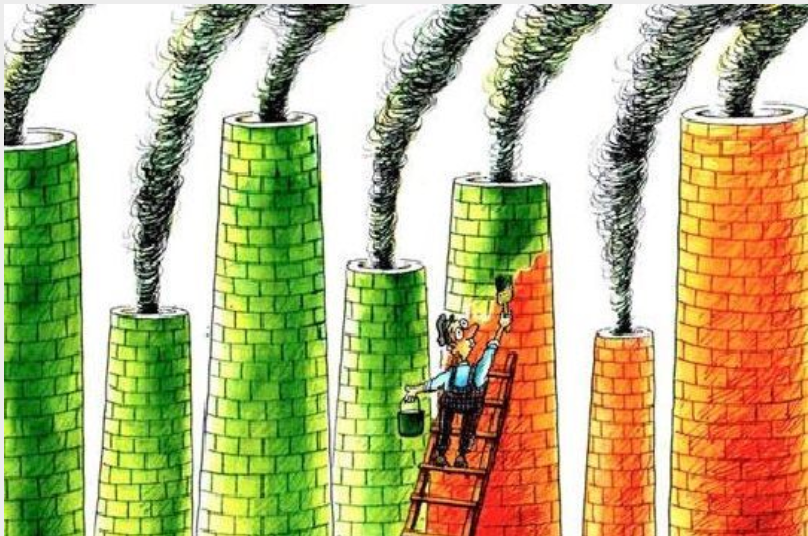
Greenwashing in progress: a fresh coat of paint won’t clear the air.
The lack of transparency is a main part of what’s letting fast fashion perpetuate not just greenwashing but also child labor, low pay, and unsustainable working conditions.
Clothing used to be made to last a lifetime, even multiple lifetimes when considering how clothes are passed down from one generation to the next. Nowadays, when shopping for clothing, it can seem almost impossible to find something made with even 100% cotton or linen. Most pieces are made from chemical fabric blends such as polyester and acrylic because it’s cheap and easy to mass-produce.
Recently, I was talking with my mom about this issue and she told me what she experienced when she wanted to buy a new pair of leggings from Lululemon: “Trying them on in the store, I can even tell then and there that they aren’t how they used to be.”
She’s owned the same pair of Lululemon wide-leg yoga pants for over a decade, taken them to the Grand Canyon, through childbirth, and, to this day, they’re in great condition. She bought them for around a hundred dollars, each dollar proving to be a worthwhile investment. In that era, otherwise known as the highly-coveted “early 2000s,” you know you were paying for the quality, not just the brand’s name.
Yet, despite the decline in quality of Lululemon, their prices stay the same as ever. As I surf their website (in the name of journalism, of course), it’s clear that nothing is under $100 dollars.
According to HerCampus, “[As] demand grows and the Lululemon brand’s revenue increases, meaningful quality is traded for profit. Although the brand has introduced a quality assurance policy to keep up with its values, in 2019, it removed pilling for one of the reasons a customer could exchange a pair of leggings. Hence, its tightened rules only show Lululemon’s unwillingness to align with its own promise.”
But the point isn’t Lululemon. It’s an example that demonstrates how the fashion industry has changed.
Instead of facing allegations and callouts from the public, many companies shy away and hide or quickly remove those minor details to not affect their overall “look”.
The decline in high quality clothing also has a direct correlation with the amount of money that people spend on clothing per year compared to historically; this can be attributed to how companies and brands have subconsciously instilled an increasing need in their consumers to buy more and more, in order to compensate for the trashy quality.
Many people rationalize and justify this back-and-forth inner dialogue. The common thought process goes like this: “$15 bucks for a top? Sweet!” to “Why is it so loose on me now?” to “I need to go shopping for a new top.” An evil, perpetual cycle.
And this process repeats itself incessantly, and it will continue to, so long as people perpetuate it. The money that they are spending buying a top just because it’s cheap and easily replaceable will end up costing more in the long run.
According to the Business of Apps, Shein was downloaded 238 million times in 2023, making it “the most downloaded fashion app of that year.”
With that many downloads, it’s safe to say that it’s going to take a lot to make people switch over or even consider alternatives.
As for the scale of this issue, it’s colossal—truly unimaginably big. In the landfills of poorer countries, our world holds billions upon billions of garments and clothing that you best believe were not used for a lifetime.
According to Waste 360, “Chile’s Atacama Desert, the driest desert in the world, is turning into one giant landfill full of old, discarded clothes. More than 66,000 tons of clothes reside at the massive landfill which is now visible from Space thanks to high-resolution satellite images.”
Approximately 65,000 tons of clothing are brought in from Europe, Asia, and North America to be dumped at the landfill. Consequently, the clothes in the landfill will start to release harmful pollutants into the air and into water channels.
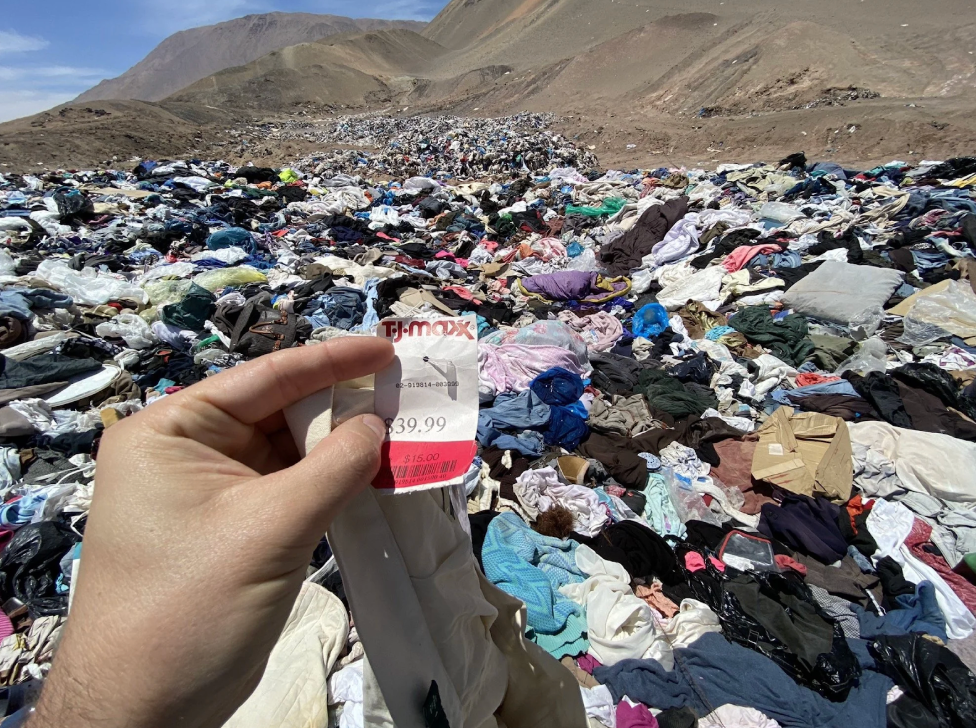
A guy showing a shirt that made its way to the landfill with the tag still on.
And where does all this trendy waste all go? Where do the clothes I aggressively toss into a trash bag and donate (in my seemingly good nature) to Goodwill end up?
“In poor people’s closets or thrift stores,” they say.
Wrong!
Thrift stores aren’t putting your old paint stained camp shirt from 2014 on their shelves. They save space for clothes that seem as if they could have a life after being purchased (again).
According to Me Mother Earth Brand, “Only 20-30% of donated clothes actually make it to thrift store shelves, where they are sold to support charitable programs. The majority of unsold items are shipped overseas, where they flood local markets or end up as waste.”
So, everything else ends up being whisked away to another place where the donors never catch a glimpse at their old rags again. What is this place, you might be wondering? Developing countries like Ghana and Kenya.
Despite my vehement opinions, don’t misconstrue my words: I don’t mean to discourage thrifting or donating clothing, because buying second-hand is always a better option!
Many associate sustainable clothing with a high price tag and exclusive with leading sustainable brands being Patagonia, Madewell, and Reformation but, it can also be affordable! Canned Goods Clothing owner Easton Dana described his brand’s goal “...to kind of align with the same pricing is like Tillys or PacSun also those shirts for thirty to thirty five forty.”
“My goal is to make the brand something people wanna wear and that they like and then think about how it is sustainable. I don't want people to buy it just because it's sustainable,” Dana said. “I want them to know that it’s just a normal apparel brand streetwear brand that also happens to be sustainable, which makes the brand itself more fun, more cool, and better for the environment.”
What Dana highlights is an amazing glimpse into how some small businesses are incorporating sustainability into their pillars because they recognize the importance and urgency.
Sustainable small business brand, Millied Clothing, owner Mary Ferguson, elaborated on the importance of long lasting clothes, “Sustainable clothing will last you a long time and as someone who really loves fashion and everything to do with clothing, I think buying clothes is an investment…you just have to be mindful of what you are buying and kind of choosing pieces that you think will last in your clothes forever, which would make buying these expensive pieces of clothes easier.”
But it’s not all doom and gloom. Fortunately, there are organizations and companies that are trying to make a difference in our world littered with fast fashion.
Subset, a sustainable “innerwear” brand makes all of its pieces from recycled fabric and partners with a textile recycling company that allows them to make their vision happen.
Everlane was named sustainable brand of the year 2023 by Glossy due to their commitment within all angles of fashion production and long-lasting pieces. Project Cece is a commerce site dedicated to many ethical fashion brands, all curated into one place.
Also, while scrolling on TikTok, as one does, I often come across many sewing and upcycling old clothing videos, which fall under the category of “slow and upcycled fashion.” Moey Slow Fashion on Instagram is a primary example of this, as many of her videos consist of “thrift flips”.
You know the saying “Reduce, reuse, recycle”? Well, it can also be applied here. We can reduce by buying more sustainable products and building capsule wardrobes that last, reuse by thrifting in thrift stores, or online on Depop and Vinted, or renting clothing (e.g. Rent the Runway). Of course, while recycling, be mindful and intentional so that we are not contributing to waste colonialism.
Lastly, passing new legislation and receiving government support will be the biggest step forward in tackling fast fashion. California is currently proposing a bill called the Fashion Act where, starting in 2026, fashion brands would be required to publicly disclose, and annually thereafter, their greenhouse gas emissions. These guidelines, at a minimum, require fashion brands to embed responsible business conduct into their policies and management systems and identify areas of significant risk for societal and ecological harm, in order to assess and mitigate the potentially harmful impacts of those risks.
Additionally, treating fast fashion like a carbon tax could also be a beneficial solution to incentivize not only companies, but also consumers to do their part.
Check out this source!


Comments