
The Mystery Mollusk

Last November, researchers finally described a new nudibranch that had stumped them for over 20 years—and it’s like no other sea slug.
In early 2000, researchers at Monterey Bay Aquarium Research Institute (MBARI) encountered a never-before-seen glowing animal. While remotely operating an underwater vehicle 8,576 feet beneath Monterey Bay, researchers were shocked to see what appeared to be a mollusk floating in the deep-water column—most mollusks inhabit shallow coastal environments, with only a few adapting to deeper habitats. Unable to identify it, the researchers dubbed it the “mystery mollusk.”
“We were looking around at each other, sort of scratching our heads,” says Bruce Robison, a co-author of the study, in an interview with NPR.
Since then, researchers have observed over 150 individuals in the wild and analyzed many more through genetic and anatomical studies; while many animals were found alone, others were seen swimming together.Researchers have officially identified and studied this remarkable species, confirming that it is unlike any other mollusk.Through thorough investigation and genetic analysis, the animal was finally confirmed to be a nudibranch. While other nudibranchs generally live in coastal environments like tidepools, kelp forests, and coral reefs and rarely close to the surface in the open ocean or on the seafloor—the “mystery mollusk” is found moving slowly, drifting through deep-water columns.
It has turned out to be a new species of sea slug—and it’s part of an entirely new family of nudibranchs, as revealed by detailed genetic analysis.
The researchers decided to name it Bathydevius caudactylus. The species name, caudactylus, refers to the finger-like projections (dactyls) on its tail, while the genus name, bathydevius, is meant to describe the “devious” way it fooled researchers for so long with its various features that differ markedly from those of other nudibranchs.All of B. caudactylus’ features help it survive in the unique environment of the midnight zone—a perpetually dark expanse between 3,300 and 13,100 feet where light cannot reach. Organisms living in this environment must be specially adapted, and B. caudactylus is no exception; meaning, its traits differ heavily from those of other sea slugs, which live in very different environments.B. caudactylus has a cavernous hood to trap prey, much like a Venus flytrap, while other sea slugs typically use their tongues to feed on prey attached to the seafloor. Although some deep-sea organisms (such as certain jellies, anemones, and tunicates) employ a comparable strategy, they are not closely related to B. caudactylus.Its diet consists mainly of crustaceans—particularly mysid shrimp—though researchers are still uncertain how it catches such fast-moving prey.The slug’s unique hood also gives it the ability to propel itself away from danger by shutting its hood quickly. However, it mostly moves through the water by drifting motionlessly through the current or flexing its body up and down to swim. The animal’s limited movement combined with its transparent body allows it to hide in plain sight, usually undetected by predators.
If threatened, B. caudactylus can emit bioluminescence. In one instance, researchers observed it glowing before detaching one of its illuminated dactyls—similar to how certain lizards drop their tails to distract predators.
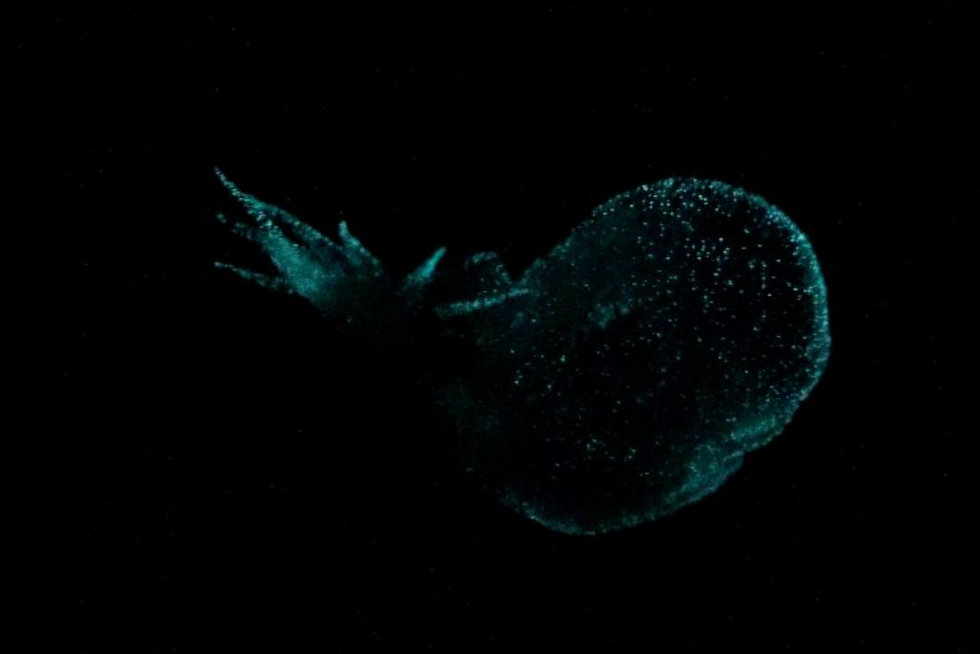
B. Caudactylus can light up with bioluminescence to startle predators.
Its breeding habits are also adapted to the midnight zone. Due to the challenge of finding a mate in such a sparse environment, every B. caudactylus individual is hermaphroditic, enabling it to pair with any other member of its species. This doubles its chances of breeding successfully, eliminating the limitation that half the population would otherwise be ineligible as a mate.
Some traits of B. caudactylus’ are shared with other nudibranchs, such as the lion’s mane nudibranch (Melibe leonina) and the veiled nudibranch (Tethys fimbria), both of which use hoods to capture prey. However, genetic analysis indicates that these similarities are due to convergent evolution, and the species are only distantly related.
“What is exciting to me about the mystery mollusc is that it exemplifies how much we are learning as we spend more time in the deep sea, particularly below 2,000 meters,” said MBARI marine biologist Steven Haddock in a press release. “For there to be a relatively large, unique, and glowing animal that is in a previously unknown family really underscores the importance of using new technology to catalog this vast environment. The more we learn about deep-sea communities, the better we will be at ocean decision-making and stewardship.”After puzzling researchers for two decades, B. Caudactylus has finally been officially described, and it’s been revealed to be the sole member of a newly described nudibranch family, an incredible discovery that shows just how much is left to be understood about the marine life living in the midnight zone.


Comments