
Oh Georgia, No Peace I Find
Georgia’s disputed election portraying a pro-Russia majority has prompted protest.
Tensions are high in Georgia. With conflicts between Azerbaijan and Armenia, the most drastic governmental shifts in Türkiye since the fall of the Ottoman Empire, and Russia being an international powerhouse at war, Georgia is sometimes lost in the middle and pushed into obscurity.
In late November and early December, the world looked to Georgia to determine how a proxy battle between the European Union (EU) and United States versus Russia would unfold. The main actors are Georgian President Salome Zourabichvili and Prime Minister Irakli Kobakhidze.

President Zourabichvili and Prime Minister Kobakhidze
Zourabichvili is pro-Western and supports Georgia joining the EU. Georgia was in consideration to be a member of the highly-coveted union, but that will be set aside over the next four years given the election results.
Back in 2018, Zourabichvili won the presidency in a landslide but the influx of hundreds of thousands of Russians following the commencement of the Russo-Ukrainian War and increased Russian influence in Georgia.
Polls show that 80 percent of Georgians want to join the EU and that is one of the main reasons thousands in Tbilisi are heeding President Zourabichvili’s call to peacefully protest. The protesters have used lasers and fireworks as a means of self-proclaimed self defense.
Prime Minister Irakli Kobakhidze of the pro-Russia and anti-Western political party—Georgian Dream—represents the force against the protesters and says that the elections were free and fair.
There has been an abundance of support from Western countries for the protestors as they have been beaten by the police.
“I praise the brave determination of Georgian people to continue on the path to Europe. Your will should be respected. No more business as usual. The EU is on your side,” says European Commissioner for Enlargement Kos Marta.

European Commissioner for Enlargement Kos Marta
“The Georgian Dream Party has announced that it will freeze the country’s EU path. This is a radical change from the previous policy, which was based on the country’s constitution. The nationwide protests show the strong desire of Georgians to continue on the European path. Their protests should not be suppressed. Finland stands with the Georgians,” says Finnish President Alexander Stubb.

President of the Republic of Finland Alexander Stubb at his inauguration
The current situation in Georgia especially showcases how far Georgia has veered away from what is laid out in its constitution.
“Article 9– Inviolability of human dignity: Human dignity shall be inviolable and shall be protected by the State. Torture, inhuman or degrading treatment, and the use of inhuman or degrading punishment shall be prohibited. Article 10– Rights to life and physical integrity: Human life shall be protected. The death penalty shall be prohibited. The physical integrity of a person shall be protected” reads the 1995 Constitution.
From Venezuela to Georgia, there have been elections that have not been rejected by many vital international actors. Given the results of the election that has claimed to have many irregularities, Georgia will not consider European Union membership until the end of 2028. Many are horrified as there is already the war in Ukraine, which is now coupled with pro-Russian Georgians. In short, Georgia is shifting away from a Western and European focus, leaning increasingly toward alignment with Russian politics.
Russia already annexed Crimea, Donetsk, and Luhansk but Georgia fought off Russia in 2008. In 2008, while Georgia lost some territory, Georgia had a pro-Western government. The parliamentary elections already went in favor of the pro-Russian Georgian Dream political party, and a presidential election was held on the fourteenth of this month.
If the parliamentary results are real, there is no reason why the Georgian Dream with nearly 54% of the vote in the parliamentary elections could not win the presidency. On the flip side, if the parliamentary elections were rigged in some way then it should not be challenging to ensure that the presidential election goes their way.
“We will do everything necessary to completely eradicate liberal fascism in Georgia. This process has already begun. These recent developments mark the start of the end of liberal fascism in Georgia,” Prime Minister Kobakhidze said.
“We also have trouble understanding the decision by Georgian authorities, led by Georgian Dream de facto leader Bidzina Ivanishvili and Prime Minister Irakli Kobakhidze, to abort negotiations with the European Union regarding the country’s accession aspirations. It was that decision, praised by Russian leader Vladimir Putin within minutes of the announcement, that triggered the latest demonstrations by tens of thousands of Georgians,” says the Friends of Georgia – former U.S. diplomats who have served in and/or worked on Georgian-U.S. relations.

Bidzina Ivanishvili in front of the flag of the Georgian Dream
The Friends of Georgia have issued a stark call to action for the United States, emphasizing the urgent need for a stronger stance against what they describe as the erosion of democratic principles in the country. They propose withholding recognition of Georgia’s October 26 parliamentary elections and the new government under Georgian Dream, citing serious questions about the elections’ legitimacy. Moreover, they stress the importance of supporting President Salome Zourabichvili’s push for a new, free, and fair elections under a reformed Central Election Commission—a move they believe could restore democratic integrity.
This appeal comes alongside a plea for the U.S. to encourage Georgia’s military and security forces to remain loyal to the constitution, particularly by resisting any orders to suppress peaceful protests. The Friends of Georgia also recommend immediate sanctions tarketing key figures, such as Bidzina Ivanishvili and Prime Minister Kobakhidhze, for their alleged involvement in authoritarian tactics and election irregularities, arguing that such measures, if coordinated with the EU, would send an unambiguous message of support for the Georgian people and their pursuit of democracy.
However, the concerns extend beyond electoral issues. State Department Spokesperson Matthew Miller recently criticized Georgian Dream for suspending Georgia’s EU accession process, calling it a betrayal of the constitutional promise to pursue closer ties with the EU and NATO. Miller explained how this decision makes Georgia more vulnerable to Russian influence.
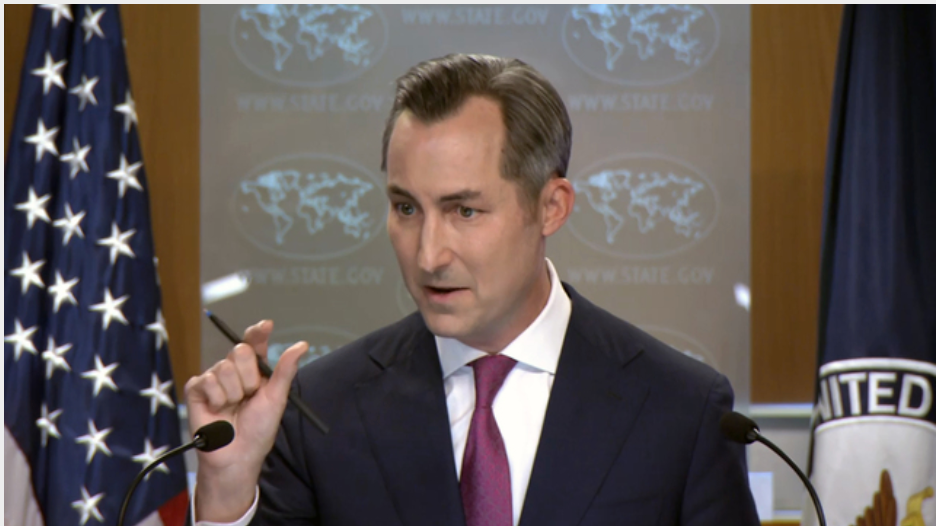
State Department Spokesperson Matthew Miller
“The Georgian people overwhelmingly support integration with Europe,” Miller stated, criticizing the Georgian government for its anti-democratic actions, which he said violate the core principles of the U.S.-Georgia Strategic Partnership. This includes democracy, rule of law, human rights, and anti-corruption efforts. Consequently, the United States has suspended the partnership mechanism. Miller also called on the Georgian government to investigate election irregularities, repeal anti-democratic laws restricting freedoms of assembly and expression, and “return to its Euro-Atlantic path.”
Such developments highlight a pivotal moment critical to Georgia’s political future. Despite widespread public support for closer ties with Europe, Georgian Dream’s actions suggest a pivot toward autocracy and alignment with Russian interests. The U.S. and its allies now face the challenge of addressing this democratic backsliding without alienating the Georgian people, who continue to demand accountability and political reform.
If the international community fails to act decisively, Georgia faces the growing danger of increasing authoritarian power, jeopardizing its aspirations for democracy and closer relations with the West.


Comments