
The Road to the Council
How City Council Candidates Are Making the Transition from Parents to Politicians.
To the average constituent, elected officials can seem as distant as a whisper in the breeze with their titles and the thousands of votes they are able to earn based on name recognition alone.
Even the layout of a typical City Hall depicts council members as more powerful than their electorate, as their chairs literally hover over civically dutiful people arguing how council measures should be voted on. Only when community members are able to gain an appreciation of the potentially treacherous journey that these would-be politicos take in reaching their lofty status, can these same constituents gain the opportunity to view their elected officials at eye-level.
“I am an unknown in the political sphere and it helps having key endorsements and being able to talk to people so that they get to know me,” says civil rights attorney and Los Angeles City Council candidate for District 11 Erin Darling.
“As a civil rights lawyer, you can affect an individual or a few dozen or hundreds of people. However, I can do so much more representing a district of almost 300,000 people. And, the ability to impact the world on a much greater scale is super motivating,” Darling said.
Darling’s passion initiated his campaign, but there is a certain amount of blood, sweat, and tears that goes into the process that is more than many potential candidates can handle. “Getting 100 ballot signatures [the requirement for candidates in Santa Monica to get onto the ballot] is not easy and that weeds out people that are not as serious,” says housing activist and Santa Monica City Council candidate Jesse Zwick.
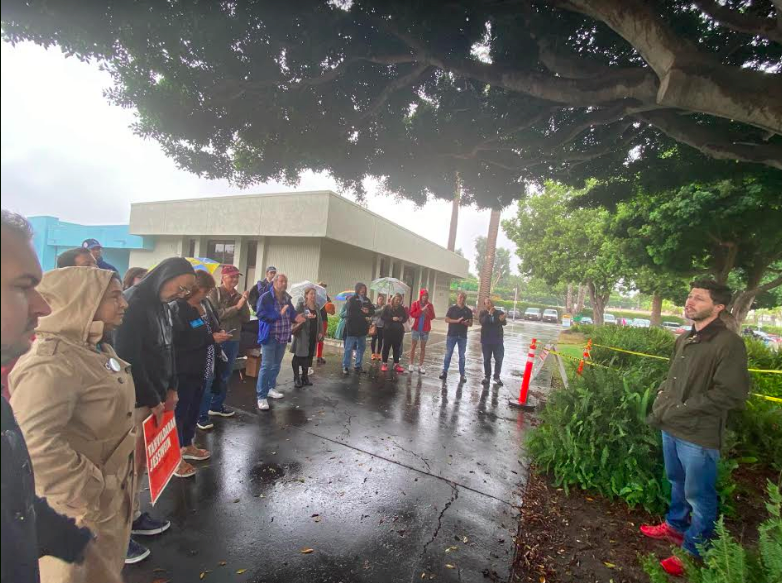
Jesse Zwick speaks to supporters at the Santa Monica Democratic Club Unity Rally at Virginia Avenue Park.
Darling agrees. “Getting onto the ballot was actually a lot of hard work. The City of LA has a signature requirement which I think is good so that candidates actually have to work to get on the ballot,” Darling said.
The hardships faced by Darling and Zwick are particularly challenging because they are both parents of young children. “I have a three and half year old. I do not get a lot of sleep and I have a lot of responsibilities, but it is fun. I try to take him to events, but it is a very busy time,” Darling said.
“It did not feel like an ideal time to run because of having a young family. I just did not see my perspective represented in the current slate of candidates and I thought that it was important to have a person that had my values. Frankly, if there was someone in the race that shared my perspective – I would just support them. It is a tough time to run, but it is important to have someone in office that knows what it is like to raise a family now. It is harder to do, but there is no representation of this demographic,” Zwick said.
For Zwick, not only has a sizable chunk of his time been consumed by the campaign, but he’s also had to worry about his financial situation, especially when running in a city of less than 100,000 people. “A lot of people in bigger races can take time off of their work to run, but it does not feel like an option financially. I put my kid to sleep at seven and then worked from eight to midnight working on campaign tasks that I was too busy to do,” Zwick said.
Putting together a successful team is the first vital step of forming a campaign. For both Darling and Zwick, this means putting together a mixture of people with experienced involvement in political campaigns, along with hard-working, yet less-experienced supporters.
The most difficult part is getting volunteers. “You have to meet people where they are when you want them to volunteer in the very beginning. I am honored that there were people that would take time out of their busy schedules to help knock on doors, call people, and host events. Then, word gets out and there is a snowball effect where more and more people get involved,” Darling said.
Racking up endorsements is very tedious. “A lot of the early parts of the campaign are talking to key leaders. You tell them why you are running over coffee. For groups, they will reach out to people that got onto the ballot with a questionnaire. That is an intense, grueling process with dozens of pages of endorsement forms. If you are thoughtful, you will be able to be interviewed and demonstrate your knowledge. It is a game of relationships,” Zwick said.
Zwick had some final words for anyone thinking about running for public office: “If you really do have that passion and you do not see your voice heard in the office, it is important to run. I don’t think it is wise to wait too long because it feels right. It was important to jump into the race earlier and get a headstart. See where there is a need and try to fill it.”


Comments