
2014 Revisited: Tracing the Roots of the Russo-Ukrainian Conflict a Decade Later

As the war in Ukraine approaches its third year, many bystanders wonder what caused this conflict to arise in a mostly peaceful continent. The answer is not so simple.
As we begin to approach the third-year mark of the Russo-Ukraine War, many speculate how the war was able to begin in Europe, a continent that has experienced varied peace since 1945. Many assume this is a conflict between an independent, sovereign country fighting for its survival against a foreign power. Although this narrative is somewhat true, there is still far more history behind one of Europe’s first wars in seventy years.
Remnants of the Cold War in the 21st century
To understand the build-up to the war between Ukraine and Russia, we must go back 30 years ago, to the dissolution of the Soviet Union.
Ukraine gained independence approximately 30 years ago on August 24, 1991. Before that point, it had been occupied by the Eastern Bloc, a coalition of communist countries that revolved under Soviet Russian control. After the German invasions of Russia in the First and Second World Wars, Russia developed a sense of insecurity against Western powers and sought domination over their neighbors to form a protective shield for the Russian heartland. The Russians used this Eastern bloc as a buffer zone against Western invasion and, as explained by the BBC, “Soviet leader Joseph Stalin wanted a buffer zone of friendly Communist countries to protect the USSR from further attacks in the future.”
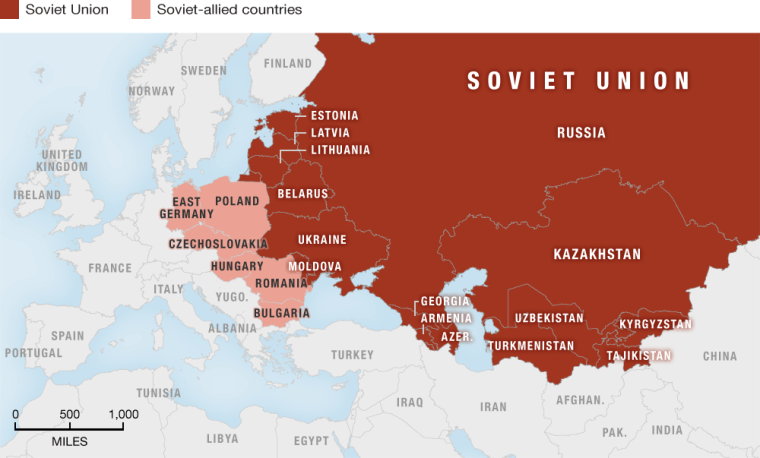
Map of Warsaw Pact, courtesy of the National Public Radio
Ukraine was one of those many territories incorporated into the Eastern Bloc that served to protect the Russian heartland. However, when the Soviet Union fell apart in 1991, several countries, including Ukraine, declared their independence from Russia as it slowly collapsed.
Although Ukraine successfully gained independence that year, Russia did not easily accept their losses after the Cold War, and had a vested interest in maintaining a level of influence in Ukrainian politics for the following decade. Russia’s primary motivation in exerting across the world began with eyes upon the Crimean peninsula.
Why Russia is so invested in Ukraine now; war of the warm water ports
The tensions between Russia and Ukraine culminated in Russia’s hostile conquest of Crimea in March of 2014. Russia’s interest in the Crimean peninsula stemmed from a desire to have access to warm water ports, which are advantageous for trade and naval domination. Russia was particularly disadvantaged when it came to global dominance with its navy, due to frozen ports that surrounded Russia’s Arctic territories. Therefore, Russian expansionism focused on areas with warm water ports such as the Crimean peninsula.
Moreover, Russia was able to easily take Crimea because of Ukraine’s Euromaidan protests in 2013. These protests occurred due to pro-Russian president Viktor Yanukovych’s unpopular decision to withdraw an association agreement between Ukraine and the EU, instead accepting a Russian trade deal. Yanukovych fled from Ukraine, seeking refuge in Russia. In his absence, Ukraine would form an interim government. However, that government would be plagued with instability and chaos, as Putin took advantage of the weak state that Ukraine was in.

Map of Crimea courtesy of the Seafoodsource
BBC News covered Putin’s claims to the illegal referendum and annexation of Crimea, as he stated that: “More than 82% of the electorate took part in the vote. Over 96% of them spoke out in favor of reuniting with Russia. These numbers speak for themselves.” Russia would hold onto Crimea from 2014 to the present day, as this event marked the beginning of hostilities between the two nations.
Continuing to take advantage of the crisis in Ukraine, Russia funded rebels in the east of Ukraine to form the states of the Donetsk People’s Republic and the Luhansk People’s Republic, which led to eight years of war between Ukraine and Russia. Despite numerous calls for peace in 2014-15 with the Minsk Accords, the war continued on.
Ukrainian goals of NATO membership
From 2015 – 2019, Russo-Ukrainian relations were relatively hostile as the war following the annexation of Crimea raged on. In 2019, tensions heightened after Volodymyr Zelensky, a former comedian, was elected President of Ukraine, promising anti-corruption reforms and improved governance. One of the first acts that Zelensky would put forward would be the adoption of a National Security Strategy, prioritizing NATO membership as a long-term goal.
This change in foreign policy greatly angered Vladimir Putin, former KGB agent, and President of the Russian Federative Republic. In a speech given in February 2022, Putin said, “I spoke about our biggest concerns and worries, and about the fundamental threats which irresponsible Western politicians created for Russia consistently, rudely and unceremoniously from year to year. I am referring to the eastward expansion of NATO, which is moving its military infrastructure ever closer to the Russian border.”
“Putin doesn’t accept that Ukraine is a real state or has a separate national identity,” says Ian Hill, a retired senior career diplomat in the New Zealand foreign ministry. “Instead [he sees it] as an integral part of the Russian national patrimony.” Russia does not believe that the Ukrainians ever should’ve been independent, rather that they are Russian citizens being controlled by a corrupt and decadent government. His views are shown through the actions he has taken to undermine Ukrainian authority through the Crimea and the Donbas War. Another reason why Russia is invading Ukraine is because of ambition.
“He wants to resist the further eastward expansion of the North Atlantic Treaty Organisation (NATO), restore Russia’s strategic depth, and reclaim its historical sphere of influence around its western borders,” said Hill. “Ukraine is central to this goal.”
The conflict escalated when Russia started building up troops near the Ukraine border in 2021 before recognizing the territories of the Donetsk and Luhansk People’s Republics in 2022. In that same year, Russian troops entered Ukrainian territory, starting the war that is still ongoing at this moment.

Map of Russia’s beginning invasion of Ukraine courtesy of The Independent
Since the outbreak of this war, Congress.gov has reported that “Russia’s military casualties, the officials said, are approaching 300,000. The number includes as many as 120,000 deaths and 170,000 to 180,000 injured troops,” Congress.gov wrote. They also wrote how many Ukrainian casualties were caused, with, “close to 70,000 killed and 100,000 to 120,000 wounded.”
Given the casualties faced during this war, it is clear that Ukrainian resolve pushes the ideals of independence against the stronger power, as it not only holds on but pushes back the once unstoppable Russian bear.
“We know what independence is. How difficult it is to revive it. How difficult it is to defend it,” Ukrainian President Volodymyr Zelensky said on Ukrainian Independence Day 2024. “But we know: everything depends on us.”


Comments